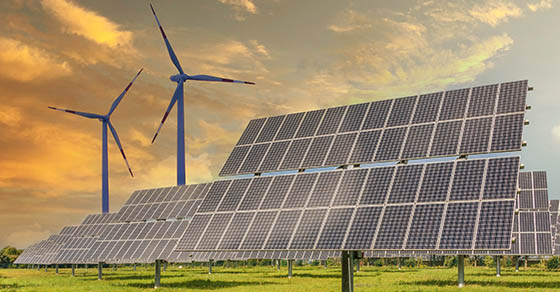
For some time, President Trump and the GOP have had their sights on repealing many of the tax incentives created or enhanced by the Inflation Reduction Act (IRA). With the enactment of the One, Big, Beautiful Bill Act (OBBBA), they’ve made progress toward accomplishing that goal. Here’s a closer look at some of the individual-related and business-related clean energy tax incentives that are being scaled back or eliminated by the OBBBA.
Clean energy tax breaks affecting individuals
The OBBBA eliminates several tax credits that have benefited eligible individual taxpayers. It provides short “grace periods” before they expire, though, giving taxpayers a window to take advantage of the credits.
For example, the Energy Efficient Home Improvement Credit (Section 25C) was scheduled to expire after 2032. It’s now available for eligible improvements put into service by December 31, 2025. The IRA increased the credit amount to 30% and offers limited credits for exterior windows, skylights, exterior doors, and home energy audits.
The Residential Clean Energy Credit (Sec. 25D) was scheduled to expire after 2034. It’s also now available only through December 31, 2025. The IRA boosted the credit to 30% for eligible clean energy improvements made between 2022 and 2025. The credit is available for installing solar panels or other equipment to harness renewable energy sources like wind, geothermal or biomass energy.
Clean energy tax breaks affecting businesses
The Alternative Fuel Vehicle Refueling Property Credit (Sec. 30C) for property that stores or dispenses clean-burning fuel or recharges electric vehicles will also become unavailable sooner than originally set by the IRA. The credit — worth up to $100,000 per item (each charging port, fuel dispenser or storage property) — had been scheduled to sunset after 2032. Under the OBBBA, property must be placed in service on or before June 30, 2026, to qualify for the credit.
The law also eliminates the Sec. 179D Energy Efficient Commercial Buildings Deduction for buildings or systems on which the construction begins after June 30, 2026. The deduction has been around since 2006, but the IRA substantially boosted the size of the potential deduction and expanded the pool of eligible taxpayers.
Wind and solar projects stand to take a big hit. The OBBBA eliminates the Clean Electricity Investment Credit (Sec. 48E) and the Clean Electricity Production Credit (Sec. 45Y) for wind and solar facilities placed in service after 2027, unless construction begins on or before July 4, 2026. Wind and solar projects begun after that date must be put in service by the end of 2027.
In addition, wind energy components won’t qualify for the Advanced Manufacturing Production Credit (Sec. 45X) after 2027. The law also modifies the credit in other ways. For example, it adds “metallurgical coal” suitable for the production of steel to the list of critical minerals. And, for critical materials other than metallurgical coal, the credit will now phase out from 2031 through 2033. The credit for metallurgical coal expires after 2029.
Note: The OBBBA permits taxpayers to transfer clean energy credits while the credits are still available (restrictions apply to transfers to “specified foreign entities”).
Clean vehicle credits
If you’ve been pondering the purchase of a new or used electric vehicle (EV), you’ll want to buy sooner rather than later to take advantage of available tax credits. The Clean Vehicle Credit (Sec. 30D) was scheduled to expire after 2032. Under the OBBBA, the credit is available only through September 30, 2025.
The IRA significantly expanded the credit for qualifying clean vehicles placed in service after April 17, 2023. For eligible taxpayers, it extended the credit to any “clean vehicle,” including EVs, hydrogen fuel cell cars and plug-in hybrids. The maximum credit for new vehicles is $7,500, based on meeting certain sourcing requirements for 1) critical minerals and 2) battery components. Clean vehicles that satisfy only one of the two requirements qualify for a $3,750 credit.
The IRA also created a new credit, Sec. 25E, for eligible taxpayers who buy used clean vehicles from dealers. The credit equals the lesser of $4,000 or 30% of the sale price. It also expires on September 30, 2025.
Additionally, the OBBBA targets the incentive for a business’s use of clean vehicles. The Qualified Commercial Clean Vehicle Credit (Sec. 45W) had been scheduled to expire after 2032. It’s now available only for vehicles acquired on or before September 30, 2025. Depending on vehicle weight, the maximum credit is up to $7,500 or $40,000.
Other limitations
The OBBBA also limits access to the remaining clean energy credits for projects involving “foreign entities of concern” and imposes tougher domestic content requirements. The CJ Group Tax team can help you plan for accelerated expiration dates on repealed clean energy incentives and comply with the new restrictions going forward.
© 2025